The Future of EdTech and VR in Schools: How Immersive Learning is Transforming Classrooms
Discover how Virtual Reality (VR) is shaping the future of education. Learn why schools are adopting immersive learning, the benefits of VR classrooms, and how SparkVR helps students understand complex concepts through real experiences.
 Sanjana Singh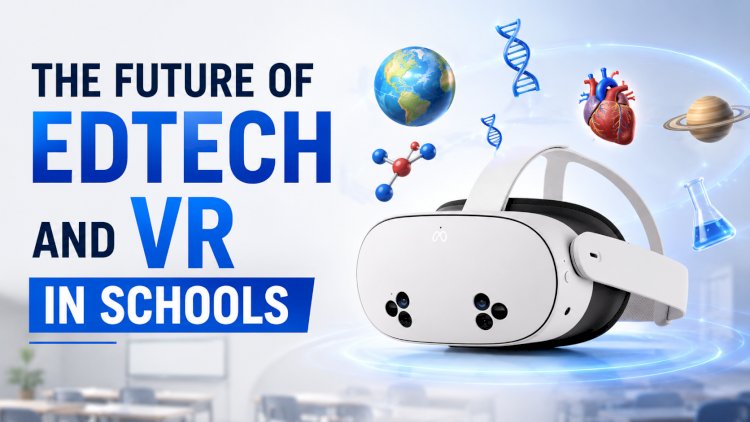
The Revolution Every School Is Waiting For
Education is changing faster than ever. Traditional classrooms are evolving into interactive learning environments where students don't just read concepts—they experience them.
One of the biggest innovations driving this transformation is Virtual Reality (VR). As schools continue adopting modern teaching methods, VR is becoming a powerful tool that helps students understand difficult concepts through immersive experiences rather than memorization. Educational technology is increasingly focused on improving engagement and concept clarity through interactive learning experiences.
Why Traditional Learning Needs an Upgrade
For decades, education has relied on textbooks, diagrams, and classroom explanations. While these methods remain valuable, many subjects are difficult to visualize.
Imagine trying to understand:
-
The human circulatory system
-
Planetary motion
-
Chemical reactions
-
Ancient civilizations
-
Internal anatomy
-
DNA structure
Students often have to imagine these concepts, making learning more difficult.
Virtual Reality changes this completely.
Instead of imagining, students can step inside the lesson.
What is VR in Education?
Virtual Reality (VR) creates immersive, three-dimensional learning experiences that allow students to interact with educational content in a realistic environment.
Instead of looking at a picture of the solar system, students can travel through space.
Instead of reading about the human heart, they can explore it from the inside.
Instead of memorizing historical facts, they can virtually walk through ancient civilizations.
This makes learning more engaging, interactive, and memorable.
How VR is Shaping the Future Classroom
The classroom of tomorrow isn't replacing teachers.
It's empowering them.
Modern schools are moving toward experiential learning, where students understand concepts by seeing, exploring, and interacting.
Future classrooms will combine:
-
Traditional teaching
-
Smart digital content
-
Interactive learning
-
Artificial Intelligence
-
Virtual Reality
-
Experiential education
This combination helps improve understanding while keeping students actively involved.
Benefits of VR in Schools
1. Better Concept Clarity
Students understand abstract topics much faster when they can experience them visually.
Complex scientific concepts become easy to grasp through immersive simulations.
2. Higher Student Engagement
Interactive lessons naturally capture students' attention.
Instead of passive learning, students actively participate in every session.
3. Improved Knowledge Retention
Research shows that immersive experiences can improve student motivation and engagement, making lessons more memorable when thoughtfully integrated into teaching.
4. Safe Learning Environment
Students can perform virtual science experiments, explore volcanoes, or travel into space without any physical risk.
Learning becomes exciting while remaining completely safe.
5. Supports Different Learning Styles
Every student learns differently.
VR helps visual, auditory, and kinesthetic learners by combining observation, interaction, and exploration.
6. Encourages Curiosity
Students naturally ask more questions when they experience lessons rather than simply reading about them.
Curiosity leads to deeper learning.
Why Schools Are Investing in Educational VR
Schools today are preparing students for careers that may not even exist yet.
Future-ready education requires:
-
Critical thinking
-
Problem-solving
-
Creativity
-
Digital literacy
-
Experiential learning
Virtual Reality supports these goals by creating engaging, technology-enabled classrooms while complementing existing teaching practices.
SparkVR: Bringing Future Learning to Today's Classrooms
At SparkVR, we believe students shouldn't have to imagine difficult concepts—they should experience them.
Our immersive learning platform is designed specifically for schools and offers:
-
Curriculum-aligned VR modules
-
Teacher-guided classroom sessions
-
Structured 40-minute learning experiences
-
Science, Mathematics, Social Studies, and more
-
Easy integration into existing school schedules
With 500+ curriculum-aligned modules, partnerships with 260+ schools, and 10,000+ students engaged, SparkVR helps educators make learning more interactive without disrupting their academic routine.
The Future is Experience-Based Learning
Education is no longer limited to books and boards.
Tomorrow's classrooms will focus on helping students experience knowledge instead of memorizing it.
Schools that embrace immersive technologies today are preparing learners with stronger conceptual understanding, higher engagement, and future-ready skills.
Virtual Reality is not replacing education—it is enhancing it.
Ready to Transform Your School?
If you're looking to introduce immersive, curriculum-aligned learning into your classrooms, now is the perfect time to explore Virtual Reality.
Whether you're a school principal, educator, or institution planning for the future, SparkVR can help you create engaging classroom experiences that students remember long after the lesson ends.
Book a free school demonstration today: SparkVR
Discover how immersive learning can make your classrooms more interactive, engaging, and future-ready. Visit SparkVR to learn more or connect with our team for a personalized walkthrough.