Benefits of VR Learning in Schools: Why Virtual Reality Is Changing the Way Students Learn
Explore the benefits of VR learning in schools and how virtual reality improves concept clarity, student engagement, retention, and experiential learning. Learn how schools and parents can use VR education to make learning more effective and future-ready.
 Sanjana Singh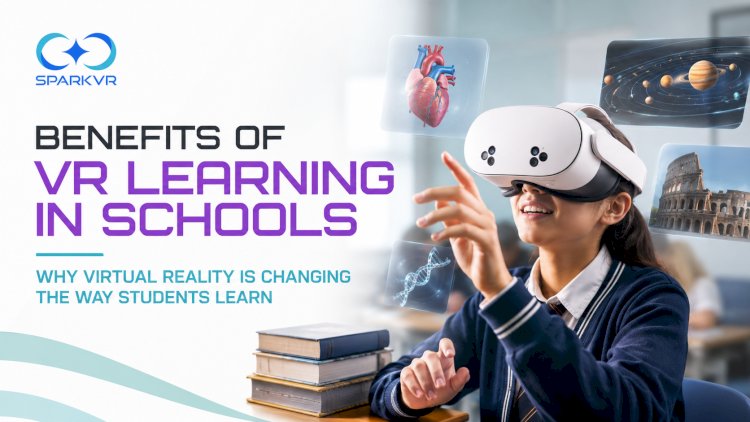
Benefits of VR Learning in Schools: Why Virtual Reality Is Changing the Way Students Learn
Education has always aimed to do one thing well: help students understand. But in many classrooms, some concepts remain difficult not because the child is not trying, but because the topic itself is hard to imagine from a textbook, diagram, or lecture alone.
A student may memorise the parts of the human heart, but still struggle to understand how blood flows through it. They may learn about planets, cells, magnetic fields, or ancient civilisations, but never fully visualise them. This is where VR learning in schools is beginning to make a meaningful difference.
Virtual Reality (VR) in education gives students a way to experience lessons instead of only reading or hearing about them. It turns abstract concepts into something visual, immersive, and easier to understand. For schools, it creates a more engaging classroom experience without moving away from academic goals. For parents, it offers a learning environment where children can understand difficult topics more clearly and stay more interested in what they are learning.
Platforms like SparkVR are building this model specifically for schools through curriculum-aligned modules, 40-minute structured sessions, and teacher-guided delivery, so immersive learning can fit into regular classroom systems instead of becoming a separate activity. SparkVR describes its approach as making concepts “observable” while integrating into existing academic schedules and subjects such as Science, Mathematics, and Social Studies.
In this article, we’ll look at the real benefits of VR learning in schools, why virtual reality in education is gaining attention from educators and parents, and what schools should consider before adopting it.
What is VR learning in schools?
VR learning in schools means using virtual reality technology to help students learn through immersive, 3D experiences. Instead of only reading a chapter or watching a diagram on a screen, students can step into a lesson and explore concepts in a more visual and interactive way.
For example, with VR:
-
students can explore the solar system instead of only seeing it in a textbook
-
they can observe the human body in 3D instead of memorising a flat diagram
-
they can understand historical places, scientific processes, and mathematical structures more clearly through experience
The goal of VR in education is not to replace teachers or textbooks. The goal is to improve concept clarity, engagement, retention, and experiential learning by making difficult topics easier to understand.
10 benefits of VR learning in schools
1. VR makes difficult concepts easier to understand
One of the biggest benefits of VR learning in schools is that it helps students understand topics that are difficult to visualise.
Many school subjects include abstract concepts:
-
the solar system
-
cell structures
-
internal organs
-
force and motion
-
3D geometry
-
ecosystems
-
historical monuments and civilisations
These topics are often taught through diagrams, explanations, and textbook descriptions. While that works for some students, others need a stronger visual connection to truly understand what they are learning.
VR helps by making the invisible visible.
Instead of asking students to imagine how a concept looks or works, VR can show it in a more realistic and immersive format. This makes learning easier because students can connect explanation with observation.
This is one reason school-focused platforms such as SparkVR position VR as a tool for concept clarity, not just engagement. According to SparkVR’s school learning model, the platform is designed to help students observe concepts more clearly through structured immersive modules.
2. VR improves student engagement in the classroom
Keeping students engaged is one of the biggest classroom challenges, especially when a chapter feels difficult, repetitive, or disconnected from real life.
Traditional learning often depends on how well students can stay focused during lectures, note-taking, and textbook reading. But VR changes the format of the lesson itself.
With virtual reality in schools, students are not just listening. They are exploring, observing, and experiencing the concept. That naturally increases curiosity and attention.
For example:
-
a science lesson becomes more engaging when students can observe a biological system in 3D
-
a history lesson becomes more memorable when they can virtually explore places and environments related to the topic
-
a mathematics concept becomes easier to follow when shapes and structures can be visualised clearly
This matters because student engagement is not just about excitement. Engagement affects participation, concentration, and understanding. When students are interested, they are more likely to ask questions, stay attentive, and remember what they learned.
3. VR learning can improve concept retention
One of the common problems in school learning is short-term memorisation. Students often study a chapter for an exam, write the answers, and forget most of it later.
That usually happens when learning is based only on repetition, not understanding.
VR can support stronger retention because students are more likely to remember something they experienced than something they only copied from a board. When a lesson includes visuals, movement, immersion, and interaction, it creates a stronger mental impression.
For example, there is a big difference between:
-
reading about the layers of the Earth, and
-
virtually exploring them in a guided lesson
Or between:
-
memorising the digestive system from a textbook image, and
-
observing the process through an immersive 3D environment
When learning feels real and structured, recall often becomes easier. That is one of the reasons immersive education is becoming more relevant in modern schools.
4. VR supports experiential learning in schools
Experiential learning has always been one of the most effective ways to build understanding. Students learn better when they can see, do, explore, and connect with a concept.
The challenge is that experiential learning is not always easy to bring into regular classrooms. Field visits, science demonstrations, and physical models require time, cost, planning, and infrastructure.
VR helps schools bring experiential learning into everyday teaching.
Instead of waiting for a lab, a trip, or a special activity day, schools can create immersive learning experiences inside regular classroom schedules. This makes learning more practical without disrupting the academic calendar.
SparkVR specifically presents its model around 40-minute structured sessions and teacher-guided delivery so immersive learning can fit into actual school periods rather than sitting outside the timetable.
For schools, that makes implementation more practical. For parents, it means VR is being used for meaningful learning outcomes, not just for novelty.
5. VR helps different types of learners understand better
Every classroom has students who learn differently.
Some students understand quickly through verbal explanation. Some need diagrams. Some learn better through repetition. Others need visual or practical examples before the concept makes sense.
One of the strongest benefits of VR in education is that it supports this variety in learning styles by adding an immersive visual layer to teaching.
This can be especially useful for students who:
-
struggle with text-heavy explanations
-
find it difficult to imagine 3D structures or processes
-
need visual reinforcement to understand concepts
-
lose confidence in subjects that feel too abstract
In subjects like Science, Mathematics, Social Studies, and interdisciplinary STEM learning, VR can help make topics feel more concrete and less intimidating.
Instead of creating a separate learning track, VR strengthens the main lesson by giving students another way to understand the same concept.
6. VR can reduce fear around difficult subjects
A lot of students do not dislike subjects like Physics, Chemistry, Biology, or Mathematics because they are lazy. They dislike them because they feel confused early, and once that confusion builds up, the subject starts feeling “hard” before the lesson even begins.
VR can help reduce that fear by making the first interaction with a difficult topic more approachable.
When students can actually see what is happening, the topic feels less abstract. It becomes easier to break down step by step. This can improve confidence, participation, and willingness to engage with the subject.
That matters because confidence has a direct effect on learning. When students feel they can understand a chapter, they are more likely to stay interested in it.
7. VR supports teachers instead of replacing them
One concern schools and parents sometimes have is whether technology will reduce the role of the teacher. In reality, the most effective school VR models are the ones where teachers remain at the centre of the learning process.
VR should not replace explanation. It should strengthen it.
The teacher still introduces the topic, connects it to the curriculum, guides the lesson, asks questions, and checks understanding. VR simply helps make the explanation more visible and memorable.
This is why teacher-guided delivery matters so much in school VR solutions. SparkVR highlights teacher-guided implementation as a core part of its approach, which is important because schools need technology that supports classroom teaching rather than creating extra complexity for educators.
8. VR helps schools become future-ready
Schools today are not only expected to complete the syllabus. They are also expected to prepare students for a world shaped by technology, visual media, simulations, AI, and interactive tools.
Introducing VR in education can be part of that shift.
It helps schools create a learning environment where students are not limited to passive information consumption. Instead, they become active participants in the learning process. It also shows that the school is thinking beyond conventional teaching methods and investing in tools that improve both learning outcomes and classroom experience.
For parents, this matters because they want schools to combine academic discipline with future-focused learning. For school leaders, it can strengthen the institution’s positioning as a modern, innovation-driven school that still remains serious about academic outcomes.
9. VR can add value across multiple school subjects
Another common misconception is that VR is useful only for science demonstrations. In reality, the benefits of VR learning in schools can extend across multiple subjects when the content is designed properly.
A structured school VR platform can support:
-
Science through anatomy, ecosystems, force, energy, and cells
-
Mathematics through geometry, visual reasoning, and spatial understanding
-
Social Studies through monuments, geography, and historical exploration
-
Interdisciplinary learning through future-focused, applied learning experiences
SparkVR describes its offering as a structured immersive curriculum across subjects and grades, built chapter by chapter and aligned lesson by lesson. That is important because schools need immersive learning that fits academic planning, not isolated one-time experiences.
10. VR gives parents a more visible learning experience
Parents often want to know whether their child is actually understanding what they are being taught, not just memorising it for exams.
This is where VR can create a noticeable difference.
Children are more likely to talk about a lesson they experienced than one they simply copied from the board. When a student comes home describing how they explored the solar system, observed the human body in 3D, or walked through a historical environment, the learning becomes more visible to parents too.
That matters because good learning is not only about marks. It is also about curiosity, confidence, clarity, and the ability to explain what one has understood.
For parents, the value of VR is not that it looks advanced. The real value is that it can help children understand more clearly, remember more effectively, and feel more interested in school learning.
Why schools are paying attention to virtual reality in education
Schools are under increasing pressure to improve outcomes while keeping students engaged and future-ready. At the same time, teachers need methods that fit real classroom schedules, not tools that add more work.
That is why VR learning in schools is getting attention.
When implemented well, it can help schools:
-
improve concept clarity in difficult subjects
-
create more engaging classroom experiences
-
bring experiential learning into regular school periods
-
support teacher-led instruction with stronger visual explanation
-
make learning more memorable for students
-
demonstrate innovation to parents without moving away from academics
The key is not using VR as a showpiece. The key is using it as an academic tool.
What schools should look for before adopting VR learning
Not every VR solution is designed for actual classroom use. Before adopting any platform, schools should evaluate whether it can genuinely support learning outcomes.
1. Curriculum alignment
The content should support what is already being taught in school, not sit outside the syllabus.
2. Teacher-guided classroom delivery
Teachers should be able to integrate the sessions into lessons without needing to redesign their entire teaching process.
3. Structured session format
The program should fit into school timetables and class periods.
4. Subject and grade relevance
The modules should be appropriate for the age, curriculum, and learning level of students.
5. Ease of implementation
The school should be able to adopt and manage the solution without major disruption.
6. Focus on learning outcomes
The purpose should be concept clarity, engagement, retention, and better understanding — not just “using technology”.
SparkVR positions itself around these exact classroom requirements by focusing on curriculum alignment, structured school sessions, teacher-guided implementation, and immersive concept learning for schools. If you want to understand how a school-focused VR model works in practice, you can explore SparkVR’s immersive learning platform.
How SparkVR supports VR learning in schools
As more schools explore immersive education, one of the biggest questions is whether the solution is built for real school environments or only for demonstration.
According to its platform and positioning, SparkVR is designed specifically for school implementation. SparkVR describes its learning model around:
-
curriculum-aligned modules
-
40-minute structured sessions
-
teacher-guided delivery
-
subject-wise immersive learning across Science, Mathematics, and Social Studies
-
integration into existing school systems without disruption
SparkVR also positions itself as academic infrastructure rather than entertainment, which is an important distinction for schools looking at long-term classroom use rather than one-time technology exposure.
For schools, that makes the conversation more practical: not “How do we add flashy technology?” but “How do we improve understanding in a way that works inside our academic structure?”
Is VR learning the future of schools?
VR is not a replacement for teachers, textbooks, or strong pedagogy. But it is becoming a powerful support system for all three.
The real benefits of VR learning in schools are not about making classrooms look modern. They are about making learning clearer.
When students can see a concept, explore it, and connect with it more deeply, learning becomes easier. Engagement improves. Retention becomes stronger. Difficult subjects feel less intimidating. Teachers get a better way to explain. Parents get a more visible sense of their child’s learning experience.
That is why virtual reality in education is no longer just a trend. It is becoming a practical tool for schools that want to improve concept clarity, student engagement, and future-readiness without compromising academic structure.
If your school is exploring immersive education, curriculum-aligned VR modules, or more effective classroom learning experiences, you can explore how SparkVR is approaching VR learning for schools.